
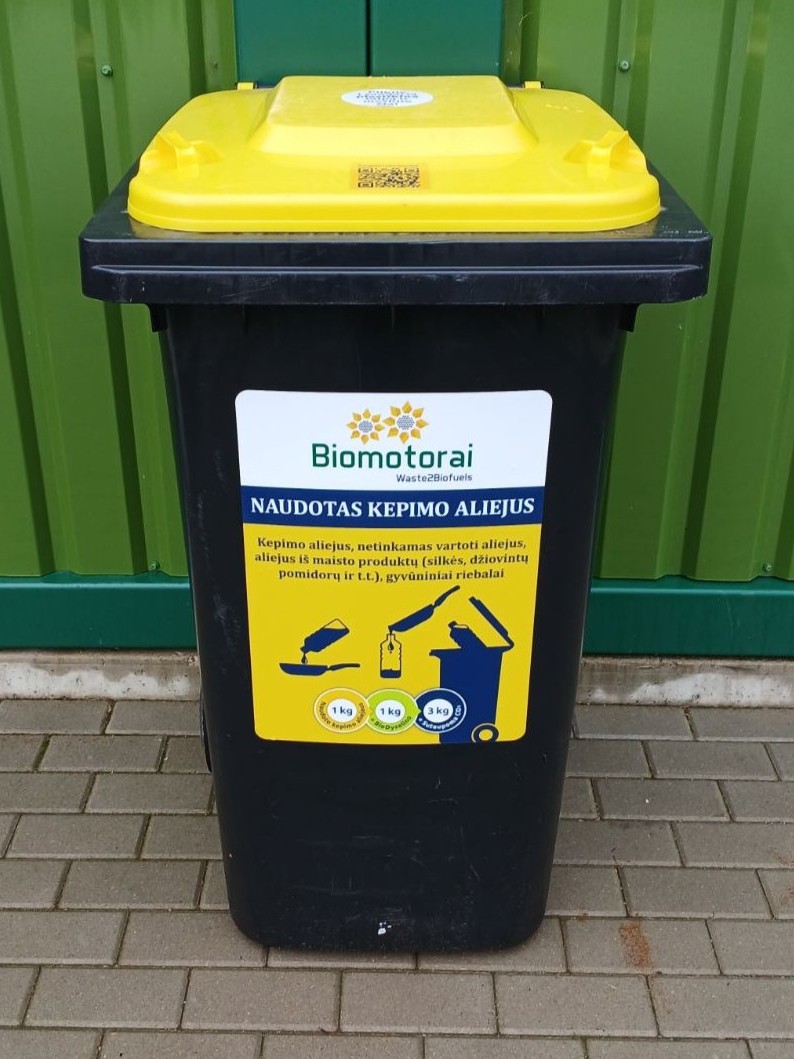
From now on, sorting will become even easier – residents of Kaunas region will be able to sort used cooking oil separately and deliver it to special containers at bulky waste collection sites.
“We are expanding our waste sorting infrastructure to make it easy and convenient for everyone to properly manage this specific waste. The simple act of putting the unusable oil in a container and taking it to the site is enough to turn waste from a problem into a benefit. ” – says Laurynas Virbickas, Director of Kaunas Regional Waste Management Centre (hereafter referred to as Kaunas RWMC).
Used oil – a waste that raises many questions
Every home has some used oil left over – grease from the frying pan, oil from a can or vegetable jar. The only question is: where to put it?
Used oil is a waste product that needs to be sorted separately. However, unlike most household waste, residents often have questions about how to deal with this waste, so it ends up where it shouldn’t – in the sewer or in household waste bins.
When poured down the sink or toilet, the oil cools, hardens and eventually forms clogs in the pipes, which not only strain wastewater systems but also pollute the environment. Meanwhile, when improperly disposed of in food or other waste containers, oil contaminates secondary raw materials that are no longer recyclable.
Collecting oil at home: a few simple steps
When the possibility of separate sorting of used oil in Kaunas region arises, it is important to know how to prepare it properly for collection.
Pour the cooled used oil into a plastic container with a tight fitting lid – this could be an empty oil bottle, a rinsed milk or water bottle, a plastic soft drink container or any other plastic container you would normally throw away. The most important thing is that the lid is screwed on tightly and that the oil does not spill out. Glass containers should not be used as they can break.
The storage container can be used for all types of used cooking oil – cooking, expired, odourless or discoloured, as well as oil from sprats, tuna, herring, canned vegetables or even animal fats. All these oils can be stored in one container and mixed together. It is important not to mix oils with other liquids such as water, chemicals, fuel residues or household chemicals. Also, food scraps or packaging should not be thrown into the bottle.
Used oil is recycled into biofuels
Properly collected, used oil becomes the raw material for biofuels – a renewable and environmentally friendly source of energy. A kilo of used cooking oil can be used to produce the same amount of biodiesel, and the CO₂ emissions from its processing are significantly lower than for conventional biodiesel production. It is estimated that recycling a kilogram of oil avoids about 3 kilograms of CO₂ emissions.
Residents are invited to try a new sorting option
Residents are invited to take advantage of a new opportunity – to deposit used oil in special containers at Kaunas RATC bulky waste collection sites. This is a simple and inexpensive service that residents can use indefinitely.
“Cooperation with Kaunas RATC helps us to achieve our main goal – to make people aware of another separately sorted waste type and to show that used oil can become biofuels. Collection at the sites is only the first step. In the future, we will strive to offer even more convenient solutions – more containers closer to people’s homes,” emphasises Andrius Rinkevičius, Biomotorai’s Project Manager.
Memo on how to sort waste oil click here.
| Kaunas | Kuršių g. 9E |
| Julijanavos g 1A | |
| Energetics str. 60 | |
| Raudondvario pl. 155D | |
| Palemono st. 12E | |
| Vandžiogala pl. 92B | |
| Chemijos str. 4E | |
| Ashigalio g. 20A | |
| Kėdainiai | J. Basanavičiaus g. 97A |
| Jonava r. | Jonalaukio k. 7 |
| Jonava | Darbininkų g. 19 |
| Raseiniai r. | Smėlynų g. 9, Gėluvos k. |
| Kalniškių k. 1 | |
| Kaišiadorys | Vytauto Didžiojo g. 136 |
| Kaišiadorys r. | Topolių g. 102, Užtakų k., Rumšiškių sen. |